Exploration

AI Travel Planning — From Search to Intent

AI Travel Planning — From Search to Intent

AI Travel Planning — From Search to Intent

What if travelers could plan an entire trip with one prompt instead of navigating dozens of search filters?

This exploration looks at how an AI planning layer could reduce that friction.

This exploration looks at how travel platforms could shift from search-driven workflows to intent-driven planning, where a user describes their trip once and receives a structured itinerary that can be refined and booked.

Context

Context

Travel planning typically begins with a simple idea.

Travel planning typically begins with a simple idea.

I want to travel to Koh Samui for a week with my family in April.

However, most travel platforms require users to translate this idea into multiple structured searches.

However, most travel platforms require users to translate this idea into multiple structured searches.

Typical workflow today:

Typical workflow today:

Each step happens in isolation.

This creates a fragmented planning process.

Each step happens in isolation.

This creates a fragmented planning process.

Problem

Problem

Travel platforms assume users already know their destination, travel dates, and accommodation preferences.

In reality, these decisions are discovered during the planning process itself.

This results in several challenges.
High cognitive load

Users must manage multiple variables simultaneously.

High cognitive load

Users must manage multiple variables simultaneously.

Repeated searching
Users repeatedly adjust filters and dates to explore possibilities.

Repeated searching
Users repeatedly adjust filters and dates to explore possibilities.

Fragmented decision making
Flights, hotels, and activities are evaluated separately rather than as a complete trip.

Fragmented decision making
Flights, hotels, and activities are evaluated separately rather than as a complete trip.

Industry Statistics

Industry Statistics

Travel Planning Is Still Fragmented

75%

75%

of travelers plan trips themselves online.

38

38

average number of sites visited when planning a trip.

4-9 hrs

4-9 hrs

average time spent researching one trip.

Despite the growth of online travel platforms, planning a trip remains a complex and time-consuming activity.

Many users restart searches multiple times due to price fluctuations or availability changes.

Approximately 25–30% of travelers still rely on travel agents, particularly for family travel and complex itineraries.

Process

Competitive Analysis

Competitive Analysis

Strengths

  • Strong accommodation discovery

  • Curated stays and experiences

  • Map-based exploration

Limitations

  • Flights not integrated

  • Planning still requires manual research

  • Limited itinerary support

Strengths

  • Massive inventory coverage

  • Robust filtering tools

  • Price transparency

Limitations

  • Separate flows for flights, stays, activities

  • Repeated searching required

  • Limited trip-level planning

Strengths

  • Competitive pricing

  • Strong mobile experience

  • Integrated travel services

Limitations

  • Planning still search-driven

  • Availability discovery requires repeated searches

  • Trip planning remains fragmented

Strengths

  • Price prediction

  • Strong mobile interface

  • Alert-based decision support

Limitations

  • Primarily focused on pricing decisions

  • Limited trip planning capability

All major travel platforms focus on search and comparison. None begin the experience with intent.

Opportunity

Opportunity

Travel platforms today optimize for search efficiency.

However the largest friction exists in the planning stage.

Introducing an AI planning layer allows platforms to assist users before structured searches begin.

Current Model

Search → Compare → Adjust → Re-search → Book

Proposed Model

Intent → AI Plan → Customize → Book

AI Travel Agent Concept

Traditional Travel Agent

Client request
Agent researches flights
Agent finds hotels
Agent recommends activities
Client reviews itinerary
Bookings finalized

AI Travel Agent

User intent
AI understands request
AI generates itinerary
User customizes plan
Bookings confirmed

AI systems now allow travel platforms to replicate the role of a traditional travel agent.

The platform becomes a digital travel planner, helping users move from idea to booking with minimal effort.

Concept Interface

Concept Interface

The AI planning system is designed to translate user intent into structured travel plans while maintaining transparency and control.

Below are the core interaction surfaces that define the user experience.

Each interface represents a key stage in the planning workflow.
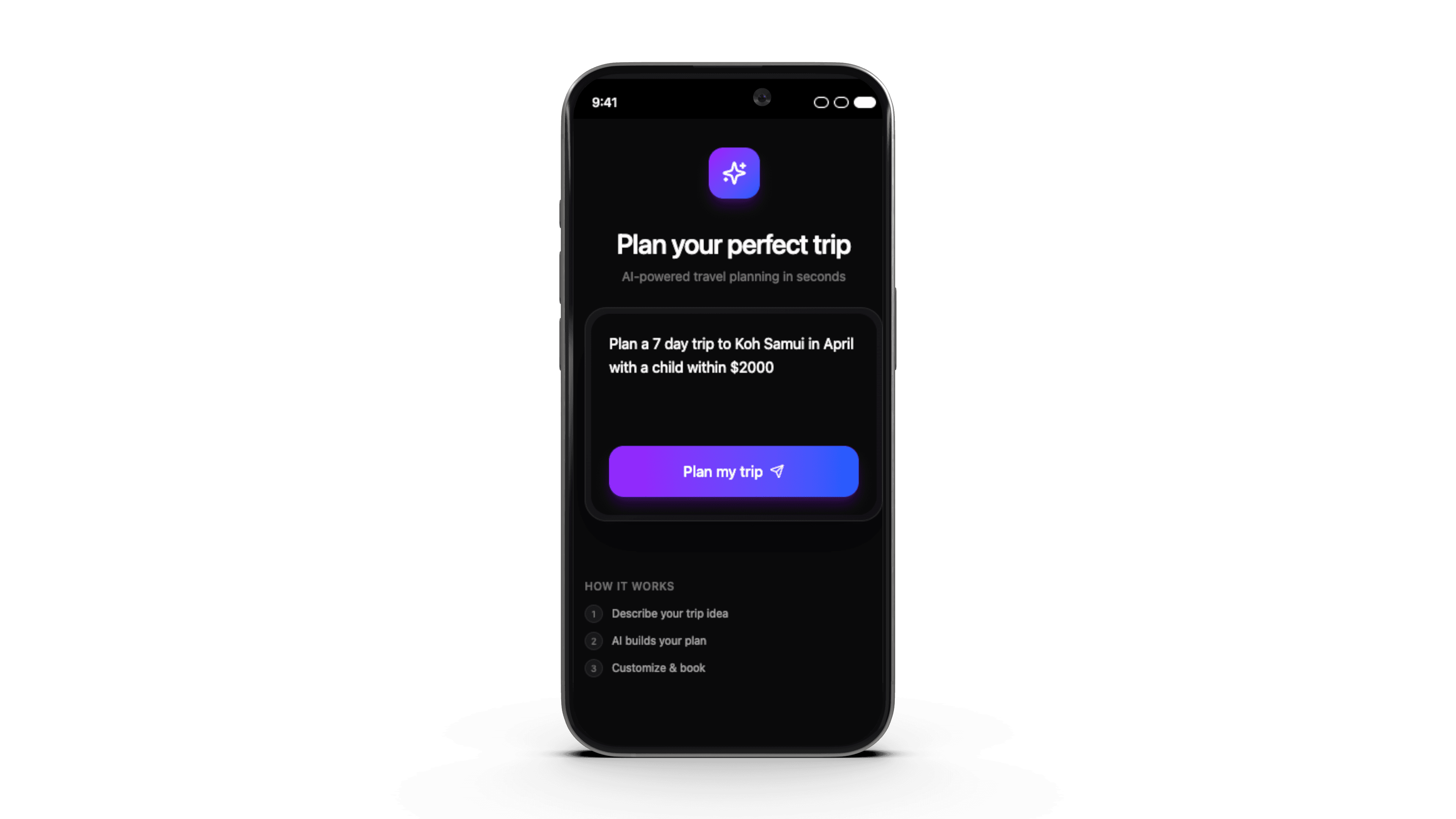
Intent Input

System behavior

The planning flow begins with a simple prompt.
Users describe their travel goals in natural language, and the system extracts key trip details such as destination, travel dates, and traveler preferences.

The planning flow begins with a simple prompt.
Users describe their travel goals in natural language, and the system extracts key trip details such as destination, travel dates, and traveler preferences.

How it appears in the UI

The interface starts as a conversational input layer where users type their trip request.
The system responds by summarizing the detected travel details as editable parameters before generating the itinerary.

The interface starts as a conversational input layer where users type their trip request.
The system responds by summarizing the detected travel details as editable parameters before generating the itinerary.

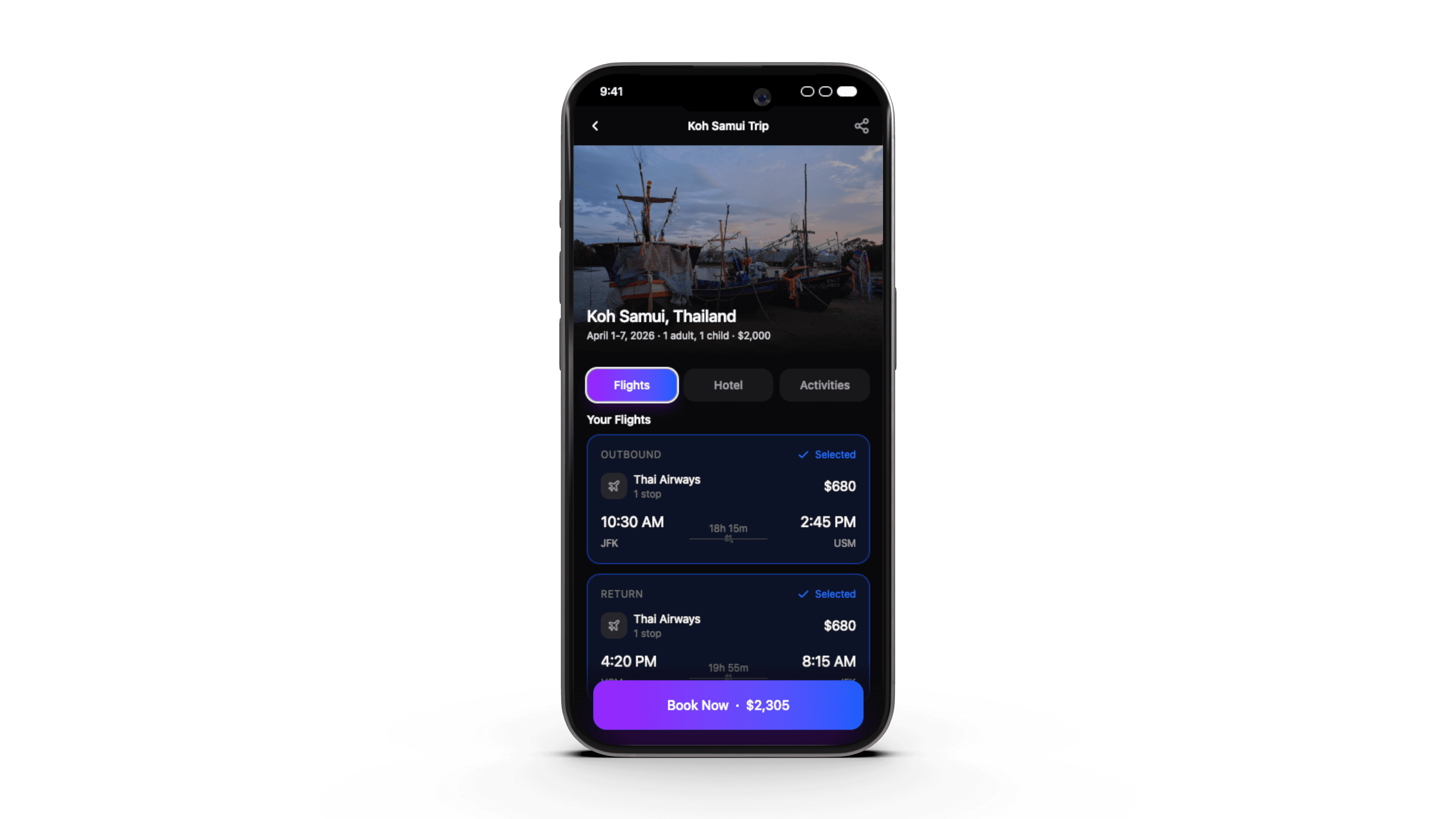
AI Generated Plan

System behavior

After understanding the request, the system generates a structured travel plan using available flight, hotel, and activity inventory.

The goal is to present a complete trip rather than separate search results.

After understanding the request, the system generates a structured travel plan using available flight, hotel, and activity inventory.

The goal is to present a complete trip rather than separate search results.

How it appears in the UI

The interface presents a trip overview with recommended flights, accommodation, and activities.
Each section appears as modular cards that users can expand, replace, or explore further.

The interface presents a trip overview with recommended flights, accommodation, and activities.
Each section appears as modular cards that users can expand, replace, or explore further.

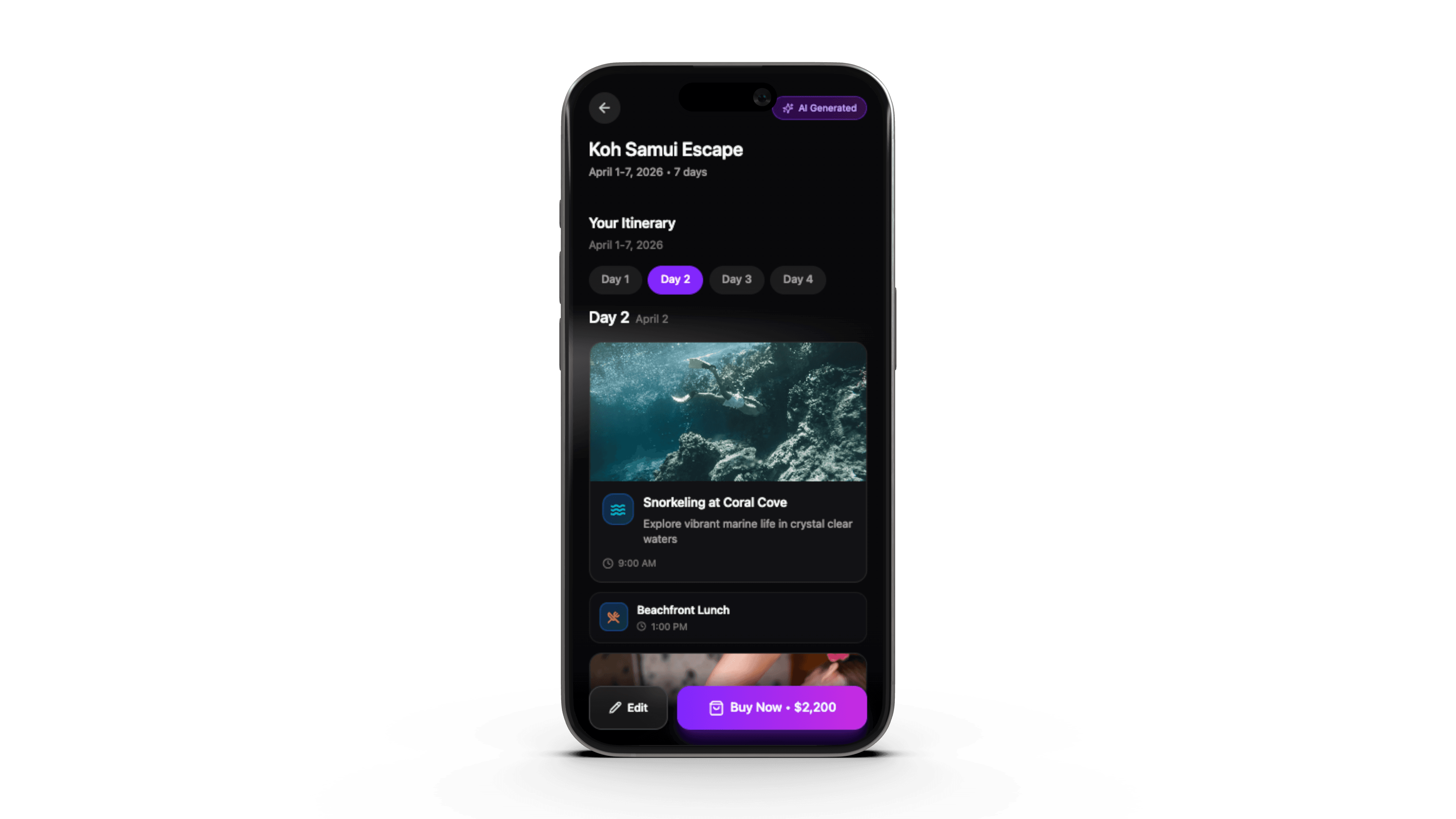
Itinerary Editor

System behavior

Trip planning is iterative.
Users can modify any part of the AI-generated itinerary while the system dynamically updates the rest of the trip.

Trip planning is iterative.
Users can modify any part of the AI-generated itinerary while the system dynamically updates the rest of the trip.

How it appears in the UI

The itinerary appears as a visual trip timeline where flights, hotels, and activities are represented as editable blocks.
Users can replace or remove elements without restarting the planning process

The itinerary appears as a visual trip timeline where flights, hotels, and activities are represented as editable blocks.
Users can replace or remove elements without restarting the planning process

Availability Assistant

System behavior

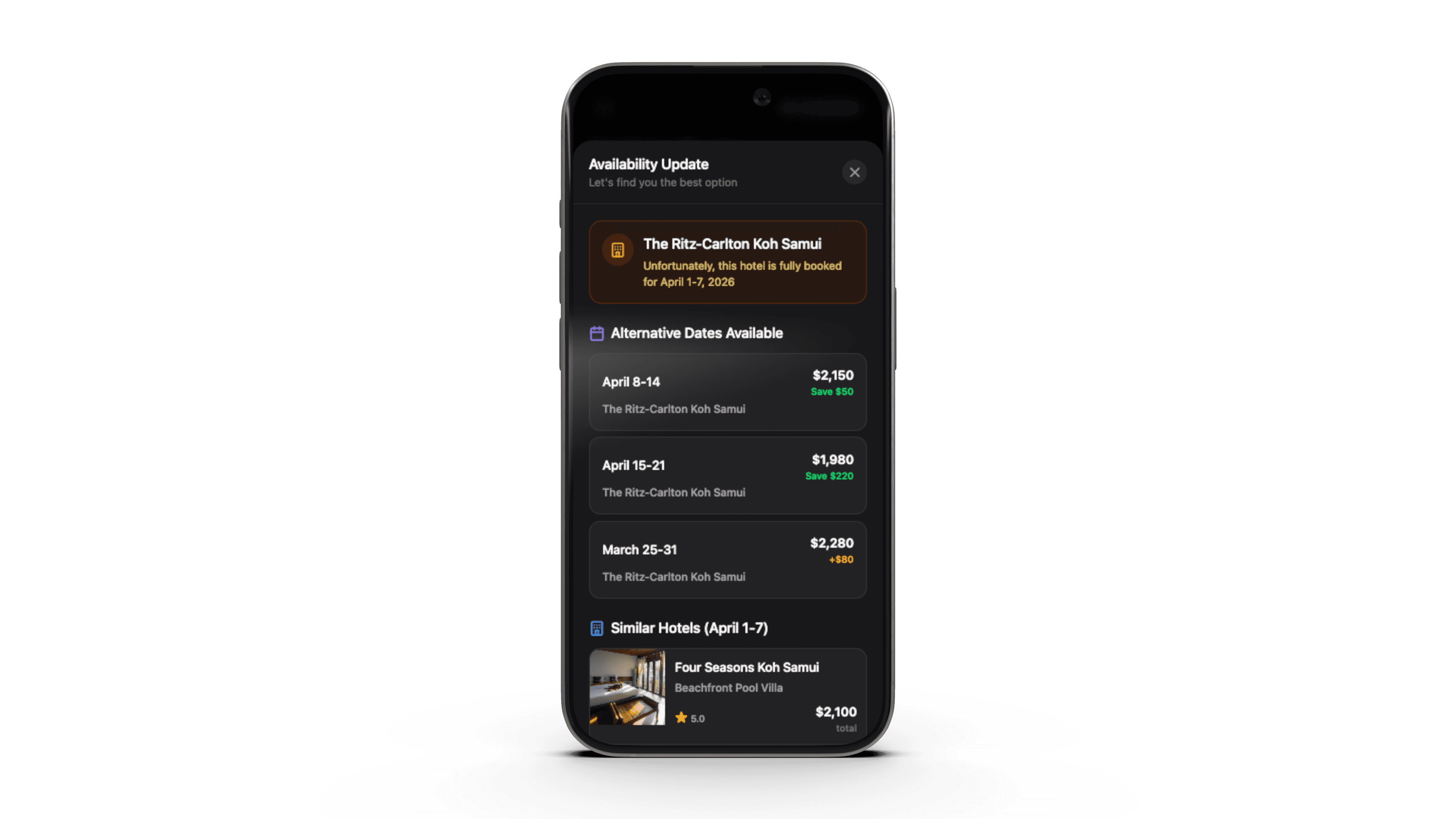
Travel availability changes frequently.
When an option becomes unavailable, the system automatically suggests nearby alternatives.

Travel availability changes frequently.
When an option becomes unavailable, the system automatically suggests nearby alternatives.

How it appears in the UI

Instead of error messages, the interface surfaces suggested dates, similar hotels, or alternative flights so users can quickly continue planning.

Instead of error messages, the interface surfaces suggested dates, similar hotels, or alternative flights so users can quickly continue planning.

The AI planner integrates multiple travel inventory systems and generates a structured trip plan based on user intent.

Users remain in control of modifying and confirming bookings.

AI Architechure

AI Architechure

User Intent Layer

Natural language input describing travel goals.

Natural language input describing travel goals.

Intent Parsing

AI extracts destination travel dates traveler count preferences.

AI extracts destination travel dates traveler count preferences.

Inventory Systems

Flight APIs
Hotel databases
Activity providers

Flight APIs
Hotel databases
Activity providers

Recommendation Engine

Generates ranked itinerary options based on availability and preferences.

Generates ranked itinerary options based on availability and preferences.

Trip Builder

Combines recommendations into structured itinerary.

Combines recommendations into structured itinerary.

Constraints

Constraints

Inventory Volatility

Flight prices and hotel availability change rapidly.

Flight prices and hotel availability change rapidly.

API Integration

Travel platforms rely on multiple inventory providers.

Travel platforms rely on multiple inventory providers.

Recommendation Accuracy

AI suggestions must balance personalization with reliable inventory.

AI suggestions must balance personalization with reliable inventory.

Key Tradeoffs

Key Tradeoffs

Automation vs User Control

Fully automated booking reduces friction but may reduce user confidence.

Fully automated booking reduces friction but may reduce user confidence.

Speed vs Transparency

Explaining why recommendations were made increases trust.

Explaining why recommendations were made increases trust.

Exploration vs Simplicity

Too many suggestions can overwhelm users.

Too many suggestions can overwhelm users.

Impact

Business & Platform Impact

Business & Platform Impact

How This Could Transform Travel Platforms

Increased Booking Conversion

Reducing planning friction can significantly increase the likelihood of booking.

Users who receive a structured itinerary early in the journey are more likely to complete a trip purchase.

Potential impact:

• fewer abandoned planning sessions
• faster decision making
• higher booking confidence

Reducing planning friction can significantly increase the likelihood of booking.

Users who receive a structured itinerary early in the journey are more likely to complete a trip purchase.

Potential impact:

• fewer abandoned planning sessions
• faster decision making
• higher booking confidence

Higher Average Trip Value

AI-generated itineraries encourage users to book more than just flights or hotels.

Trips can include:

• flights
• accommodation
• activities
• local experiences

Bundled recommendations increase cross-selling opportunities for travel platforms.

AI-generated itineraries encourage users to book more than just flights or hotels.

Trips can include:

• flights
• accommodation
• activities
• local experiences

Bundled recommendations increase cross-selling opportunities for travel platforms.

Stronger Platform Loyalty

When users rely on a platform to plan their entire trip, they are less likely to use multiple travel websites.

AI-assisted planning positions the platform as a trusted travel companion, not just a booking tool.

When users rely on a platform to plan their entire trip, they are less likely to use multiple travel websites.

AI-assisted planning positions the platform as a trusted travel companion, not just a booking tool.

The Shift From Search to Intent

The Shift From Search to Intent

Travel platforms today are built around search filters and comparison.

But travelers don’t start with filters.
They start with an idea.

By introducing an AI planning layer, travel platforms could move from transactional booking tools to intelligent travel assistants — helping users go from inspiration to booking in a single flow.

View More

Metallic shape background image

Contact

Let's Get in Touch

Interested in collaborating or learning more? Feel free to reach out.